
 Back to news
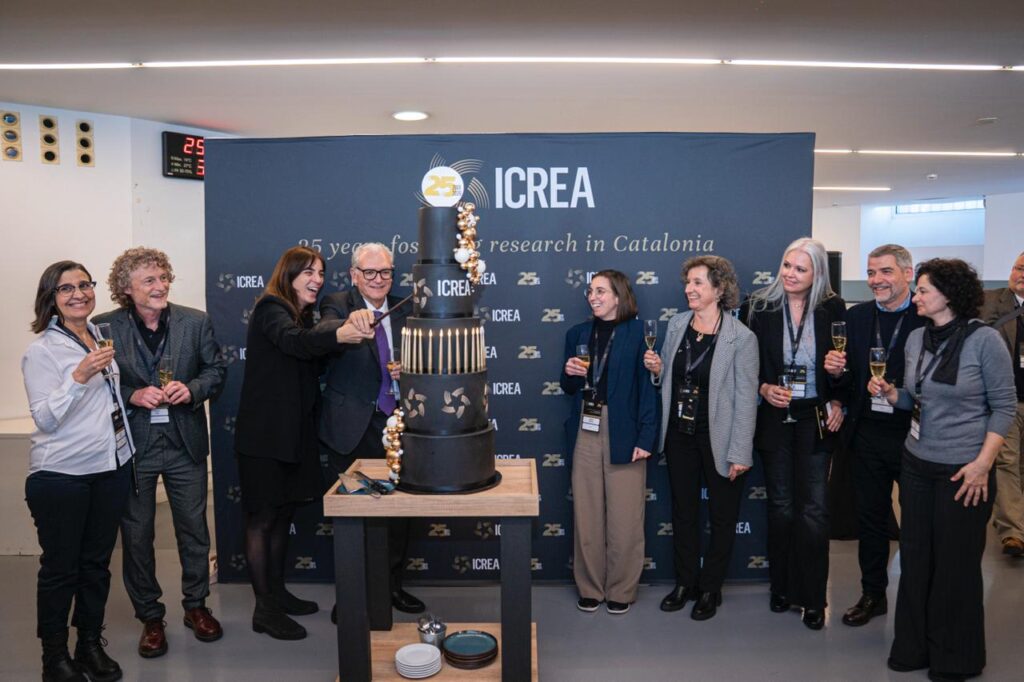
The Catalan Institution for Research and Advanced Studies (ICREA) celebrated its 25th anniversary today, Friday, February 6th, at an event held at the Centre for Contemporary Culture of Barcelona (CCCB). In addition to an institutional celebration, which concluded with remarks from the Catalan Minister of Research and Universities, Nuria Montserrat, the event highlighted a successful model that has transformed the Catalan scientific landscape.
“ICREA is an initiative that is valuable and must continue,” said the Catalan Minister for Research and Universities, Núria Montserrat, at the closing of the event. “Achieving critical mass is important to create and launch major transformative projects. And ICREA is a key part, because attracting and retaining talent is essential”, she added.
Beyond its 25-year history, the event was presented as a celebration of the future of a research community built on three pillars as simple as they are universal: international and interdisciplinary talent, research excellence, and transformative collaboration. In the CCCB auditorium, the voices of the institution’s founder, Andreu Mas-Colell; the current director, Antonio Huerta; former directors; and a dozen ICREA researchers were heard, explaining from their personal experiences and disciplines what has changed in the world of research and in Catalonia thanks to ICREA.
ICREA: an institutional commitment and a disruptive model
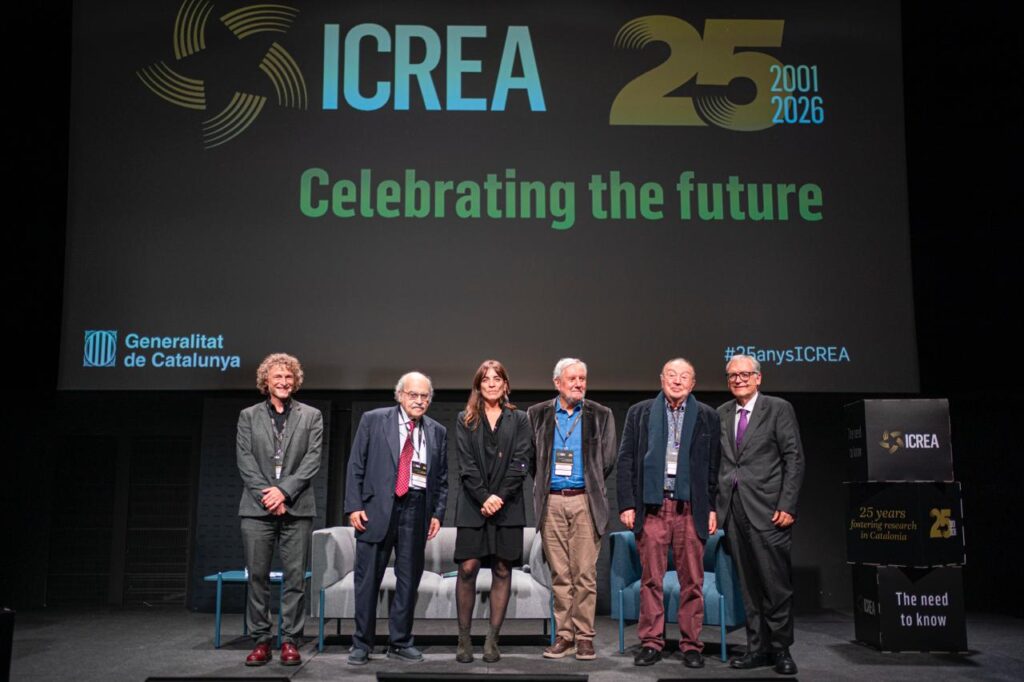
The genesis of ICREA, a quarter of a century ago, was the result of both an institutional commitment and a national project. At a time when the Catalan research system was seeking its place in the world, the Generalitat de Catalunya devised a disruptive model inspired by international best practices, but with unprecedented administrative agility. Under the impulse of Andreu Mas-Colell, at that time the Catalan Minister of Universities, Research and the Information Society, ICREA was born in 2001 with a clear mission: to attract the brightest talent from anywhere in the world and integrate it into Catalan universities and research centres. This formula not only made it possible to “import” cutting-edge science, but also served as a catalyst for the entire Catalan research system.
For this reason, a special tribute was paid during the event to the vision of Andreu Mas-Colell, who was the architect and main political and intellectual promoter of ICREA: a public foundation designed to put Catalan science on the world map. “We created labour contracts to help universities and research centers attract talent. We treated all institutions equally: anyone could hire an ICREA researcher. This benefits the strongest, but it also encourages the weaker ones to make progress”, said Mas-Colell upon receiving the award.
ICREA was created to promote research in Catalonia through new recruitment formulas designed to compete on an equal footing with other research systems. The ICREA Foundation, funded by the Catalan government, works closely with Catalan universities and research centres so that researchers from all over the world can make Catalonia their home. In this model, which champions equal opportunities and the rejection of any type of discrimination, the defining features are scientific excellence and commitment to social welfare.
A collective success
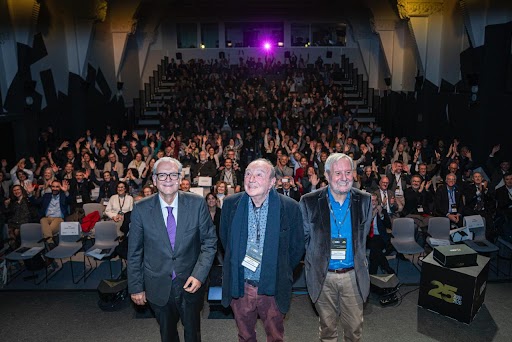
The trajectory of ICREA during these 25 years only makes sense thanks to a research system that has dared to dream big, a Generalitat government that has continued to promote this initiative despite the economic and social crises, a community that turns its desire to know into a passion for research, and a country that refuses to be a mere spectator and instead strives to buil a fairer, more solidary, and more sustainable future.
“I believe that all citizens of Catalonia should be proud of these researchers, of every discovery they make, across all disciplines. We are shaping the future together”, said Antonio Huerta, director of ICREA.
The ICREA Community currently comprises more than 300 ICREA research professors working at nine universities and 39 research centres in Catalonia. It is a team that not only excels academically but has also become a true economic and social engine.
“Researchers are a bit like police officers, surgeons, or firefighters… they have to perform, often under adverse conditions. But unlike a firefighter, a researcher also has to buy the water needed to do their job first,” explains Emilià Pola, executive director of ICREA.
Even so, the impact is easy to demonstrate with figures. The ICREA community carries out cutting-edge research that translates into more than 2,000 scientific publications per year, one third of which are among the top 10% most cited worldwide. This research community attracts competitive funds that quadruples the Generalitat’s investment in this programme. In addition, each ICREA researcher generates, on average, seven additional high-value-added jobs. In a European Research Area estimated to include more than two million researchers, a community of just 300 people in Catalonia —0.01% of the total European total— attracts 1.5% of the European Research Council grants, placing the ICREA Community among the European scientific elite.
OTHER NEWS
La nit de la Recerca
Scientists from all over Catalonia share their work through talks, workshops, demonstrations, and games for all ages at the Nit…
ERC Public Engagement with Research Awards 2026
Prof. Karim Lekadir has been recognised with one of the ERC Public Engagement with Research Awards 2026 for his work…